Social Gameplay · Dream11

Social
Gameplay

What started as a few social features became a full social gameplay ecosystem across Dream11.

Over five years, I led its evolution from a standalone social layer into a core part of the game. By 2023, social was integrated across ~40% of the app, shaping how users discover, compete and play together.

Company Dream11
Role Design Lead
Team 5 Designers, 1 Researcher
Duration 5 years2018 – 2023
Responsibilities
Product & Design Strategy Design Delivery Formative & Summative Research Design Leadership
2–3x

Year-on-year adoption and retention growth across three IPL seasons

40%

of app screens were social by 2023

10,000+

members in the largest chat groups

2M+

daily contest joins from chat during IPL

Detail has been reduced and modified to honour the NDA and confidentiality agreement with Sporta Technologies Pvt. Ltd.

The Opportunity

Why social before IPL 2019.

Dream11 had 45 million users and around 95% of India's fantasy sports market. With competition growing, the goal was to build social into the product before IPL 2019.
Key objectives

Retention

Give users more reasons to return through friends, colleagues and fellow players.

Monetization

Create more ways for users and the platform to benefit from their network.

Trust

Help users see who they know on the platform and make the experience feel more credible.

Engagement

Make fantasy sports more social through challenges, banter and shared experiences.

What social should do

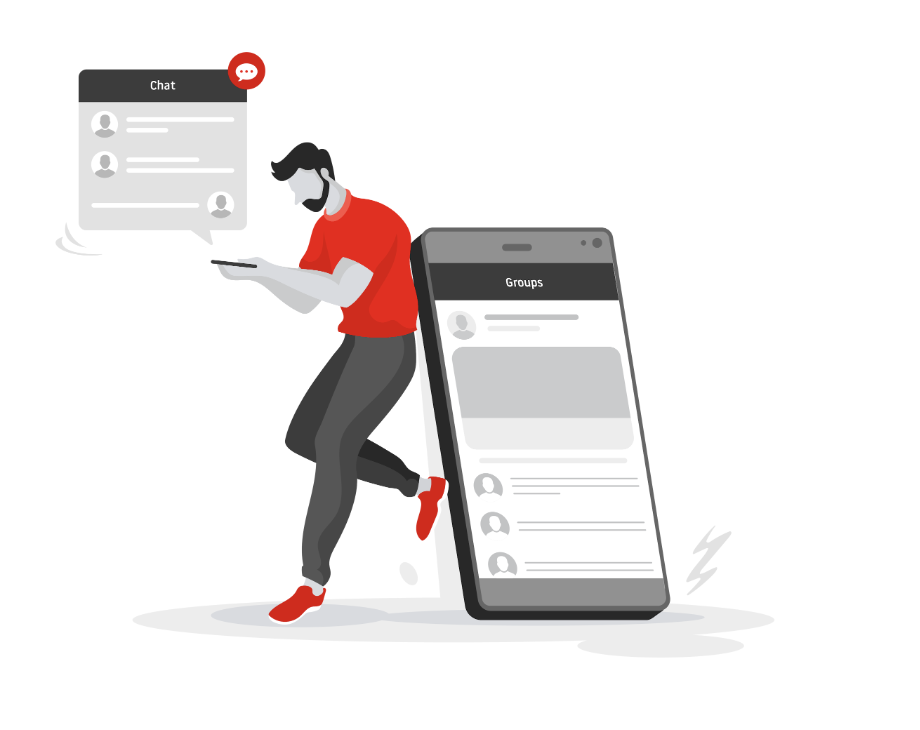
Illustration of a player chatting beside a phone showing groups
Create communitiesConnect friends, colleagues and people with similar interests.
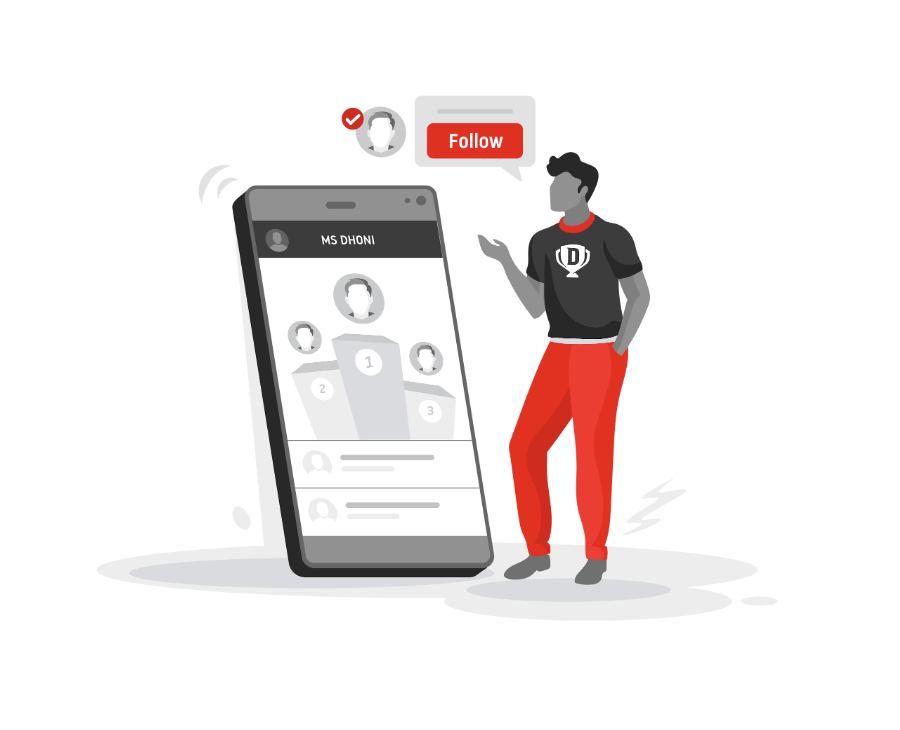
Illustration of a player being followed on a leaderboard profile
Build social equityHelp users share knowledge, build a following and establish credibility.
Illustration of two friends reacting to a contest-joined notification
Enhance gameplayHelp users learn, compete and play with people they know.

The Approach

Two phases over five years.

The work evolved through two phases: first building and validating a social layer, then using research and data to rethink how social should work within fantasy sports.

Phase 1

2019 – 2020

Build, validate and learn

Build the basic social ecosystem and understand what users actually valued.

  • Launch the foundation with POCs and MVP features.
  • Test adoption and product-market fit.
  • Continuously research user behaviour and unmet needs.

Feed, follow and UGC were built alongside the game, but engagement remained low.

Phase 2

2021 – 2023

Research, reset and evolve

Use research and product data to rethink the role of social.

  • Study behaviour across gaming, fantasy sports and social platforms.
  • Connect user needs with business goals.
  • Create a new vision, strategy and roadmap.

Social gameplay became part of the game itself, driving 2–3× adoption and retention growth across three IPL seasons.

Phase 1

Feed, Winners and Chat.

The first phase established the basic social ecosystem: a network, Feed, Winners and Chat.

Feed

Launched during IPL 2019 with follows and user-generated content, later expanding to official pages.

  • Share: Contests, teams, images and links.
  • Interact: Comments, reactions, polls, quizzes, videos and highlights.
  • Govern: Moderation, reporting, blocking and spam controls.

Feed was deprecated in 2022 as compliance requirements evolved.

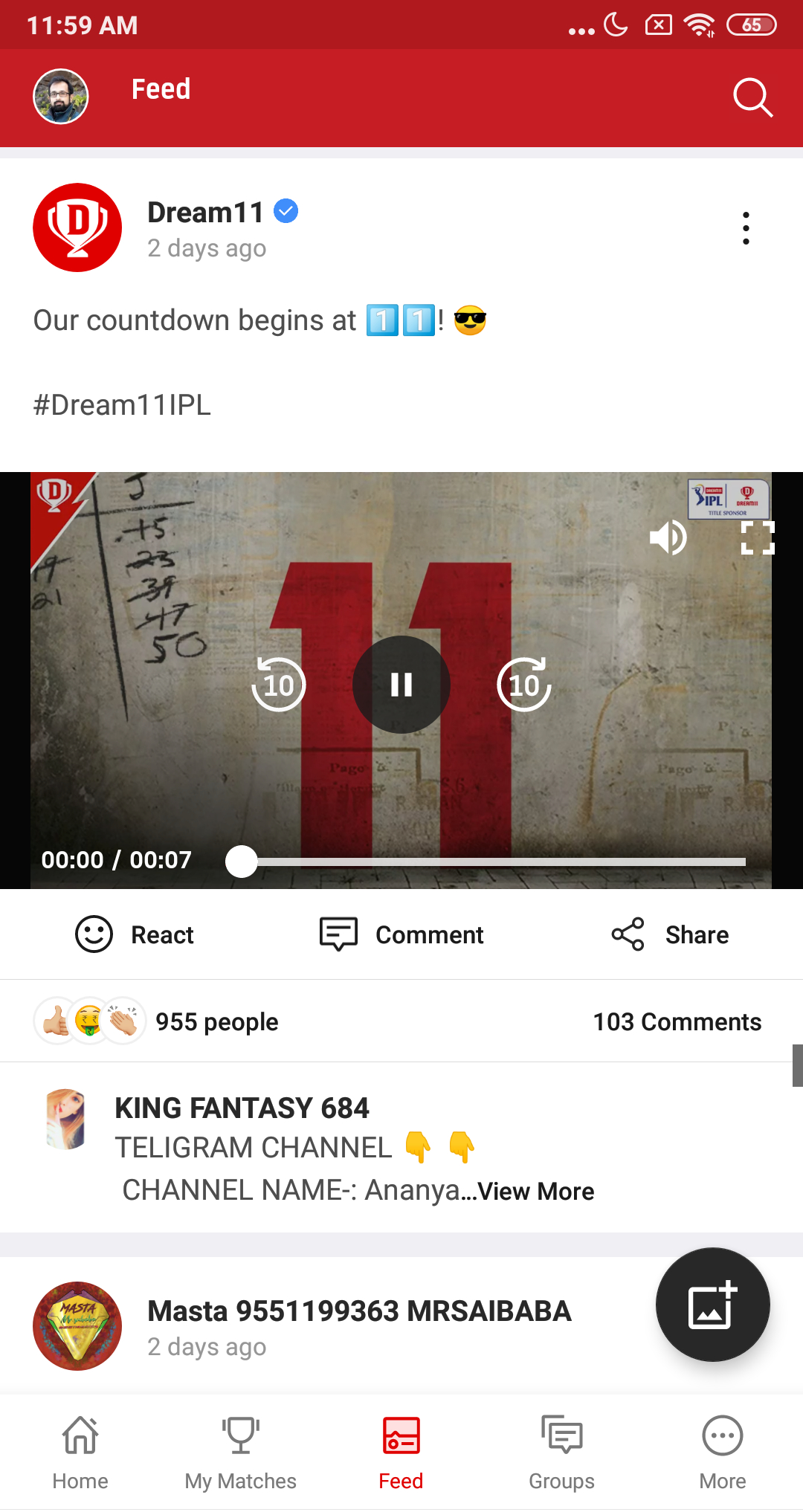
Dream11 Feed page with official page content, reactions and comments

The Feed

Official pages and video content in one stream.

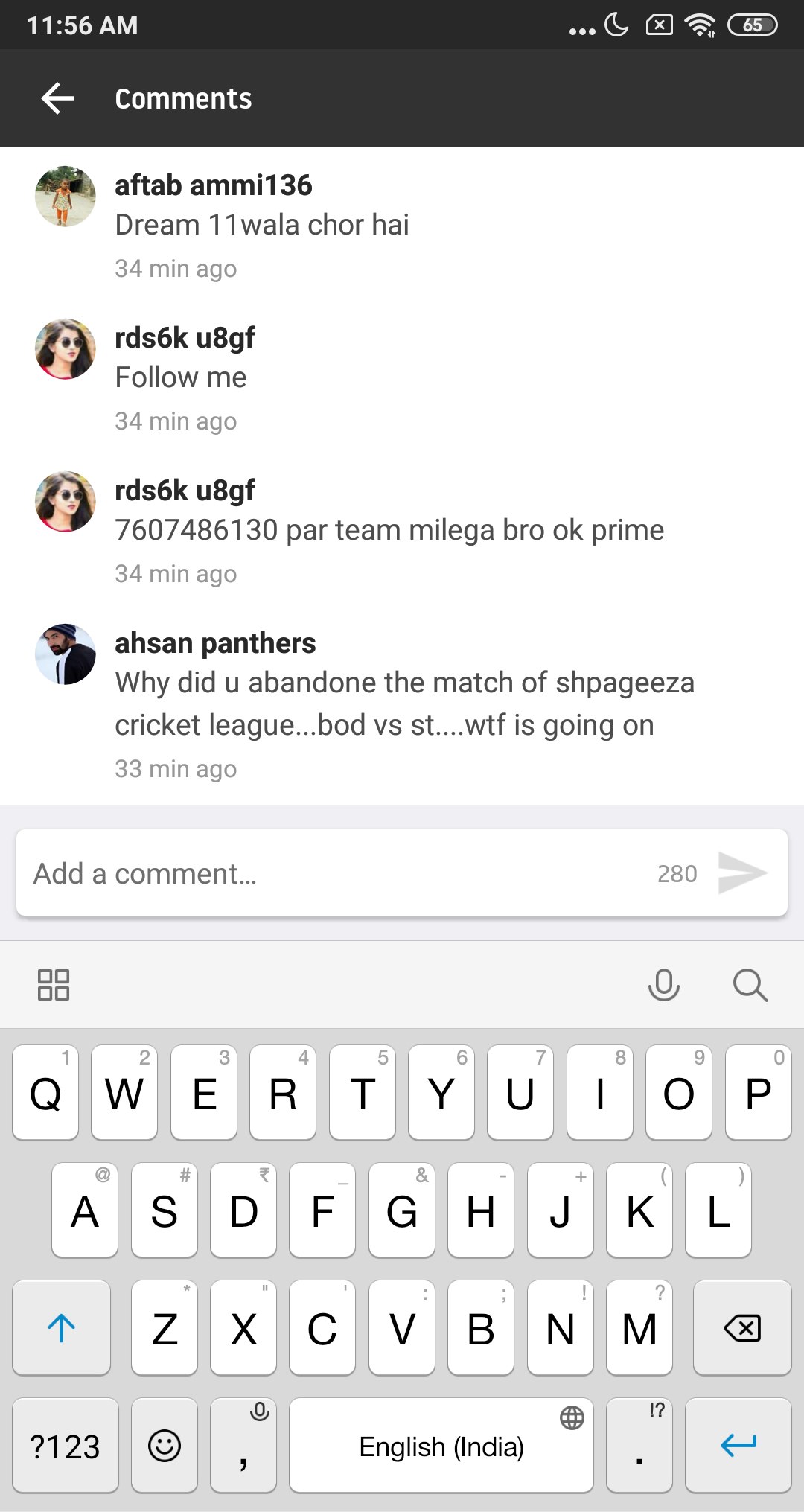
Viewing and adding comments on a Feed post

Comments and reactions

Users could respond directly to posts.

Winners

Built to show that Dream11 winners were real people.

  • View winners from every mega contest.
  • Explore winners by state, team and winnings.
  • Read winner stories from across India.

Winners

Every mega contest winner, filterable by series.

Crorepati Club

Winner stories from across India.

Impact

  • Became a standalone feature after launch.
  • Trust-related complaints declined across support and social channels.
  • Winners users showed stronger retention than the platform average.

Chat MVP

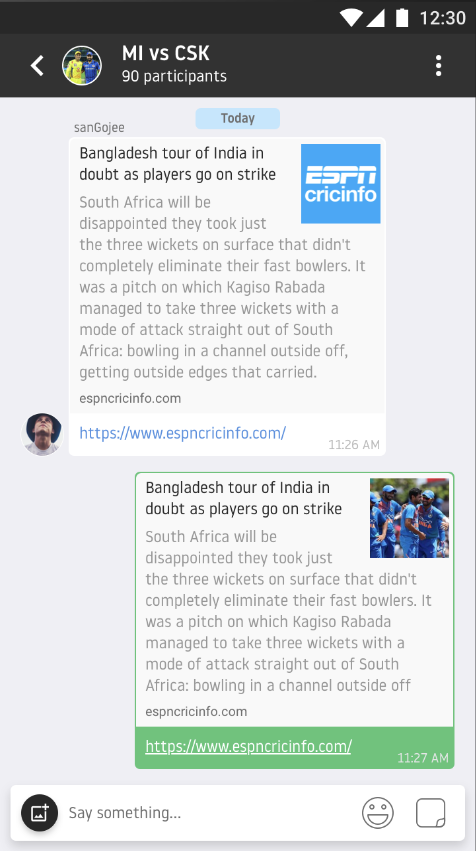
Users were already creating private contests with friends. Chat brought those conversations into Dream11.

  • Groups created through shared links.
  • Messages, images, emojis and links.
  • Private contest invites.
  • Basic moderation and reporting.
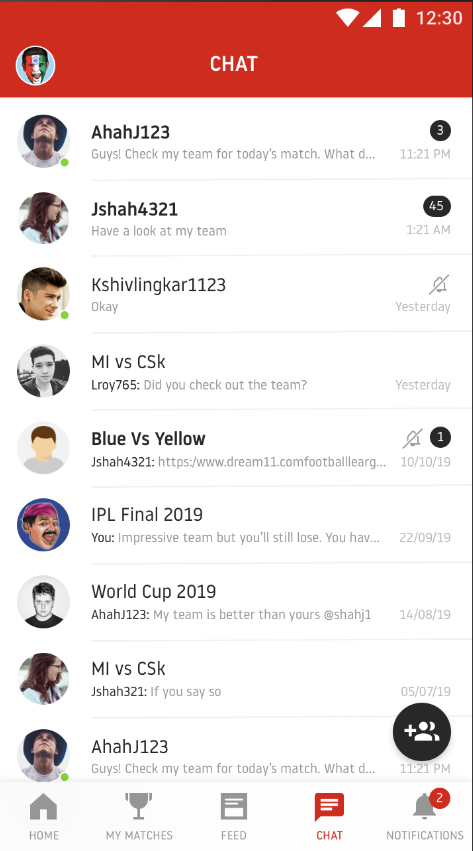
Chat MVP group list with unread message counts

Chat list

All groups with unread message counts.

Chat MVP chat window with basic texting features

Chat window

The first version focused on simple text conversations.

Phase 2

Research and reset.

Phase 1 showed that adding social features was not enough. We combined product data with deeper research to understand what users actually wanted from social gameplay.

  • Research: Contextual and behavioural research across gaming, fantasy sports and social networking.
  • Identify: User needs and problems.
  • Prioritise: Score user needs against business goals.
  • Refine: Define a clearer vision and strategy.
  • Roadmap: Turn the strategy into a focused product plan.

Five key drivers emerged from the research, with safety as a critical underlying need.

User problems

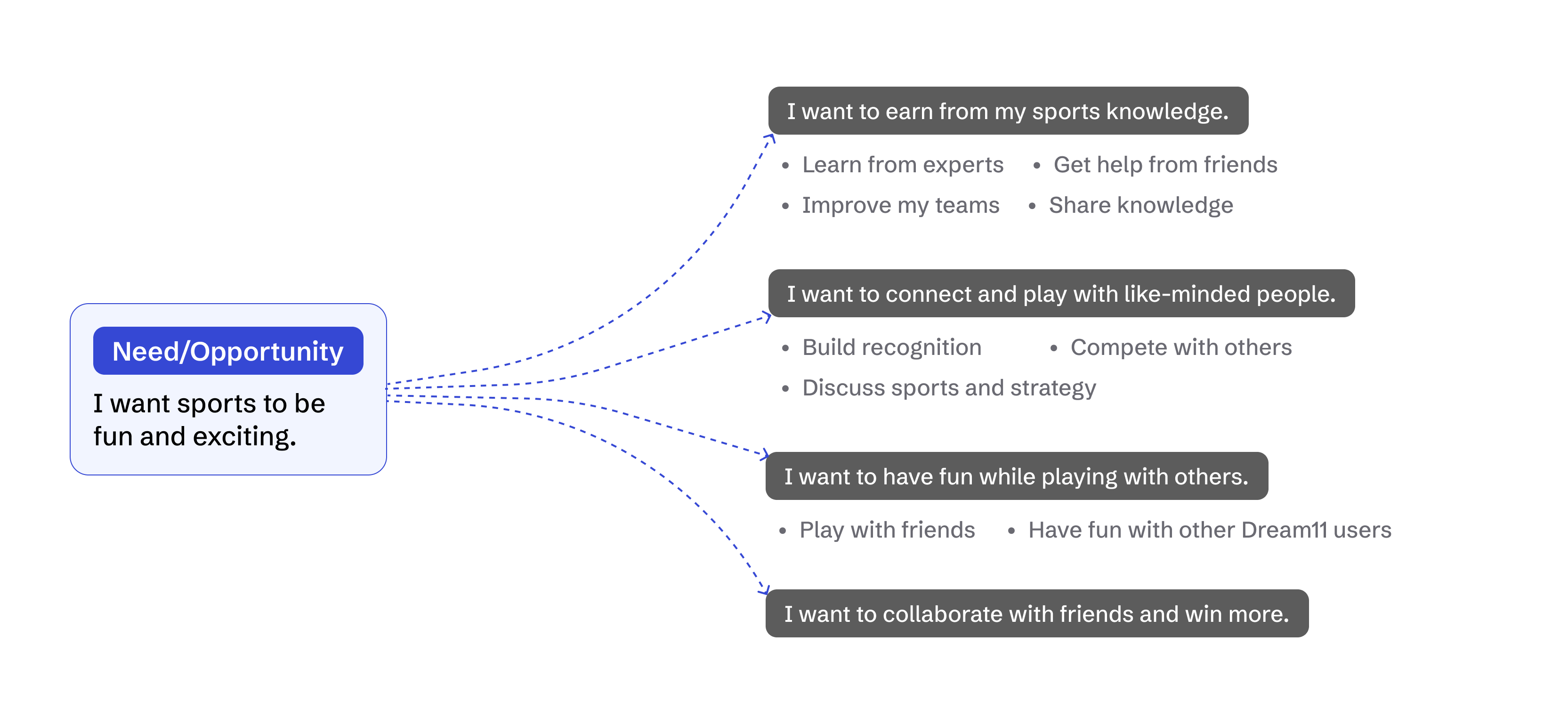
We converted research findings into user problems, mapped them to root needs, then scored them against business priorities.

User problem tree: root need "I want sports to be fun and exciting" branching into earning from sports knowledge, connecting with like-minded people, having fun while playing with others, and collaborating with friends to win more, each with its supporting user needs

Key learnings

Social gaming is not social networking

Fantasy sports needs its own social mechanics, not a copy of a social network.

Gameplay comes first

Prioritise features that improve the game over content and conversation.

Integration beats standalone features

Social features work better when they are part of the core experience.

Chat needs gameplay

Chat should help users play, compete and strategise, not just communicate.

Discovery should be easy

Users should quickly find friends and relevant players.

Safety needs to be built in

Privacy, moderation and abuse prevention need to be part of the product.

Five social archetypes

Five archetypes, measured on the two axes the research kept returning to: how socially they play and how visible they are willing to be. Each card carries its own position on both.

Monetising Influencer

Turns expertise and an audience into income.

Position: broadcasts to an audience rather than playing with them, so mid on the social axis; high public visibility.
Collaborative Influencer

Builds a following by helping others play better.

Position: plays with others; highest public visibility. The opposite corner to the Anonymous Gamer.

Competitive Gamer

Plays to win and wants recognition.

Position: plays largely alone; medium public visibility.

Anonymous Gamer

Plays seriously while keeping their identity private.

Position: plays alone; lowest public visibility. The far corner of the field.

Collaborative Gamer

Plays with friends and shares teams and tips.

Position: plays with others; low public visibility, social within a known circle.

The Pivot

From social network to social gameplay.

Research changed the strategy.

  • New vision: Build social into fantasy gameplay instead of creating another social network.
  • MLP over MVP: Prioritise experiences users would value, not just functional features.
  • New design language: Content-heavy experiences led to a broader visual and type system across the app.
  • Integrated by default: Social became part of core Dream11 journeys rather than a separate destination.
The revised vision
Bring people together
and enhance the fantasy gaming experience.

Building blocks

Find & Connect

Find friends and like-minded players.

Play & Track

Play with your network and track performance.

Discuss & Strategise

Talk about the game, share strategies and compete with friends.

Foundation

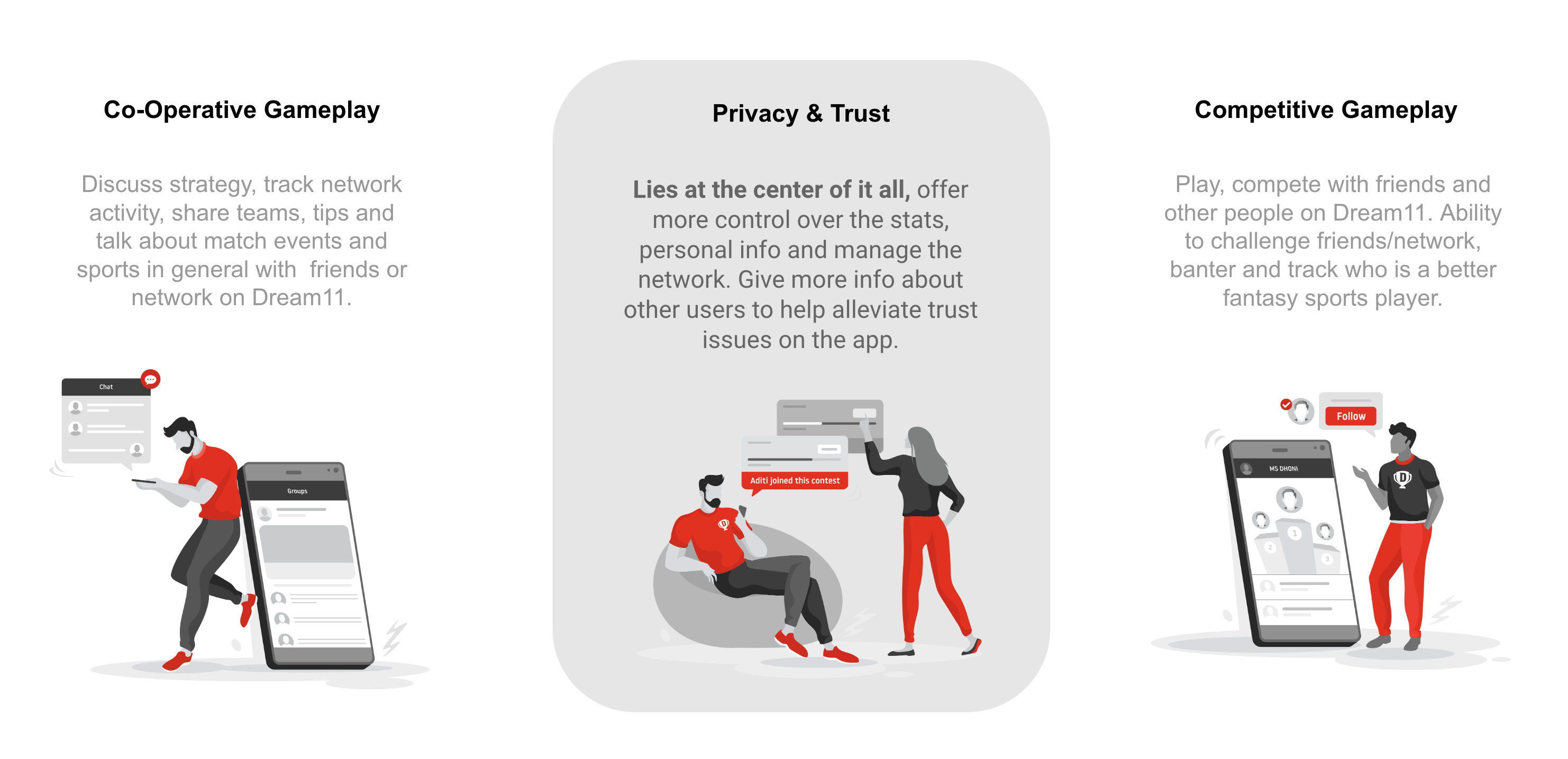
The foundation of the vision: Co-operative Gameplay and Competitive Gameplay either side of Privacy and Trust, which sits at the centre of it all

Prioritisation

Four problem areas became the foundation for the product roadmap:

  • Find & Connect: Find people and build your network.
  • Discuss & Strategise: Learn from others and share knowledge.
  • Play & Track: Challenge friends and compare performance.
  • Privacy & Trust: Control who can reach you and know who you are playing.
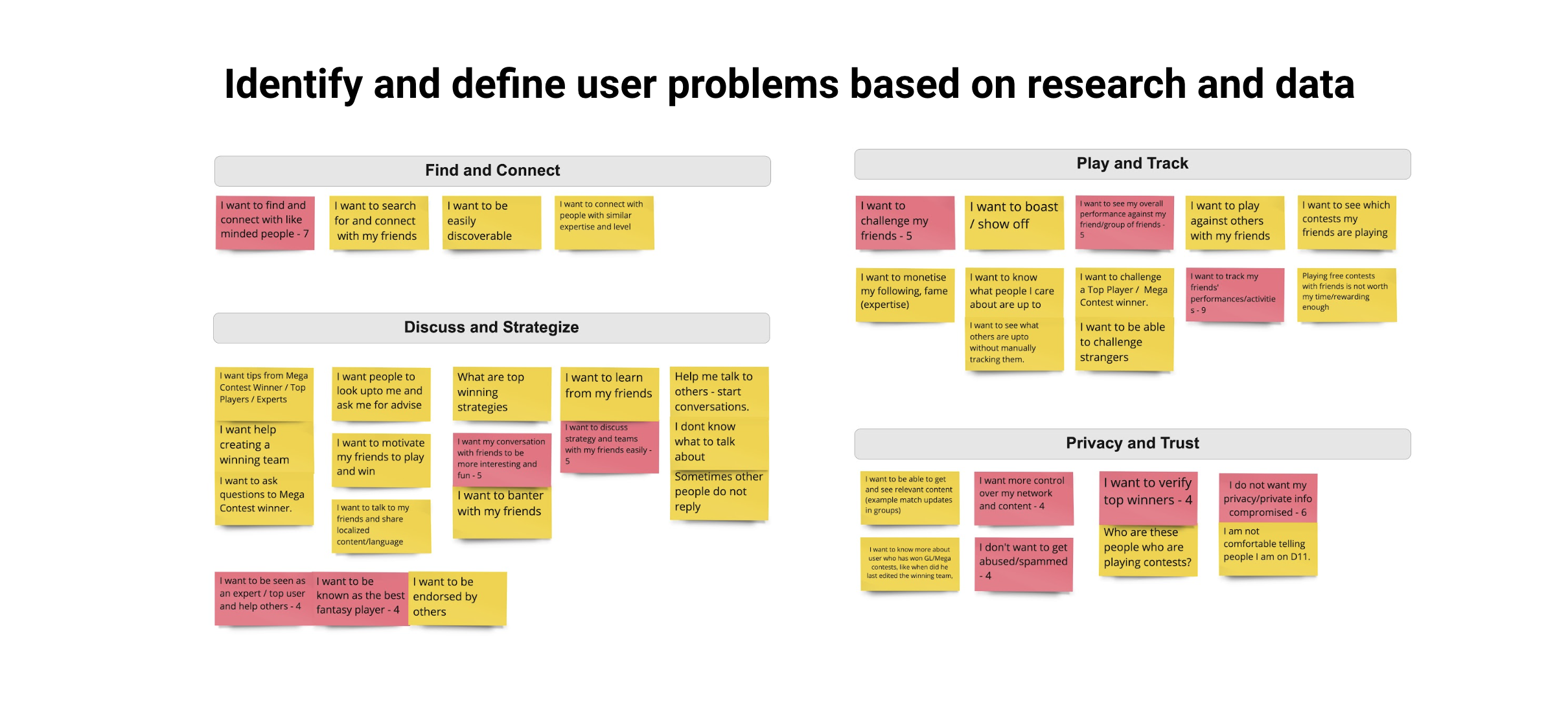
Affinity board of user problems clustered under Find and Connect, Discuss and Strategize, Play and Track, and Privacy and Trust, each note scored by priority

The affinity board

User problems were grouped, prioritised and scored to decide what to build first.

The Product

The social gameplay ecosystem.

The first phase built social alongside the game. The second brought social into the game itself.

  • What went wrong: The first version borrowed patterns from social networks and sat outside gameplay.
  • What research showed: Users wanted to know who was playing, compete with them and see how they compared.
  • Where Dream11 could win: The opportunity was not messaging. It was making contests, teams and leaderboards more social.
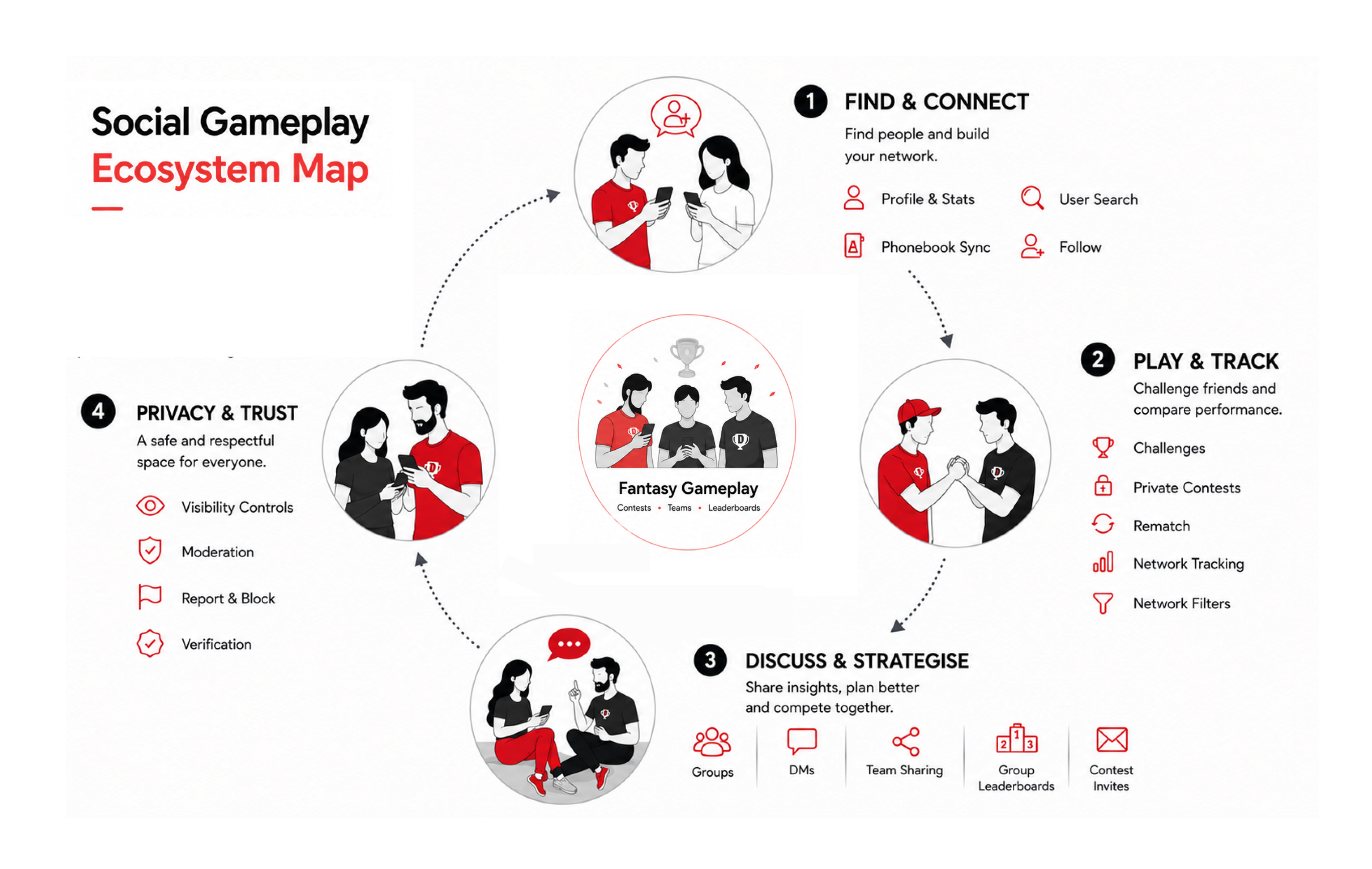
  • What changed: Social became part of gameplay. Every feature had a role in helping users find, play with or talk to others.
Ecosystem map: three areas of engagement, Find and Connect, Play and Track, and Discuss and Strategise, converging on Fantasy Gameplay at the core, which rests on Privacy and Trust as the foundation

Three areas of engagement, all feeding the same gameplay core, all sitting on the trust base. Nothing stands alone.

Find and know the people you play with

Finding someone on Dream11 starts with trust. Users need to know who they are following, messaging or challenging.

  • Search: Find players by name and connect with them.
  • Mini profile: See who someone is without leaving the current screen.
  • Full profile: Lead with gameplay: matches, contests, performance and win rate.
Third-person profile with quick actions and comparative career stats, own profile and network, and search: a mini profile for quick view, a full profile emphasising gameplay and social context, team compare, and user search with phonebook sync

Impact

  • Trust-related queries fell by roughly 8%.
  • Profile visits and team comparisons also increased after the gameplay-focused profile was introduced.

Make contests more social

Contests are at the heart of Dream11. Challenges and private contests made them easier to play with people you know.

  • Direct challenges: Challenge someone from a DM, profile or group.
  • Private contests: Create and share contests with friends and groups.
  • Rematch: Challenge the same players to another 2–10 member contest after the game ends.

Private contests

Share contests to a group or externally.

Rematch

Back into the same group.

Impact

  • Challenges and private contests drove a larger share of contest joins.
  • Engagement and retention were strongest in small groups of 4–7 members, with 15% higher retention than Mega Contests.

Track your network throughout the match

The role of the network changes during a match. Before it starts, users want to know who is playing. Once it begins, they want to see how everyone is performing.

  • Before the match: See who from your network has joined and challenge them.
  • During and after the match: Track teams, points and rankings across contests.
  • Compare performance: See where the difference between teams comes from.
  • My Network: Find and track people you know throughout the match.
Network tracking in two states. Pre match start: the network band on the home match card opening the list of who from your network is playing, and the same band above individual contests. Post match start: a contest leaderboard with the My Network toggle off and on, the Compare ranks band on My Contests, the match level My Network tab ranking every team your network created, and the Compare Teams breakdown

Impact

  • Network filters, tabs and toggles became repeat behaviours across matches.
  • Surfaces showing network activity also saw higher contest and match joins, with familiar players acting as social proof.

Chat built around the game

Chat was more than messaging. It connected conversations directly to fantasy gameplay.

  • Messaging: Text, links, images, GIFs, reactions and emojis.
  • Groups: Support both small friend groups and larger communities with moderation and reporting.
  • Gameplay objects: Share contests, teams and challenges directly in chat.
  • Live standings: See scores and rankings without leaving the conversation.
The chat tab from zero state to channels with contest invites, group leaderboard rank and head to head, contest invites grouped by upcoming match, and chat navigation from any leaderboard back to its channel
Chat window layout and details: the group leaderboard band, automatic group contest and system-generated messages, direct messages with a head-to-head summary, user stats, and gameplay-first native chat objects for shared teams and contest cards

Keep groups active

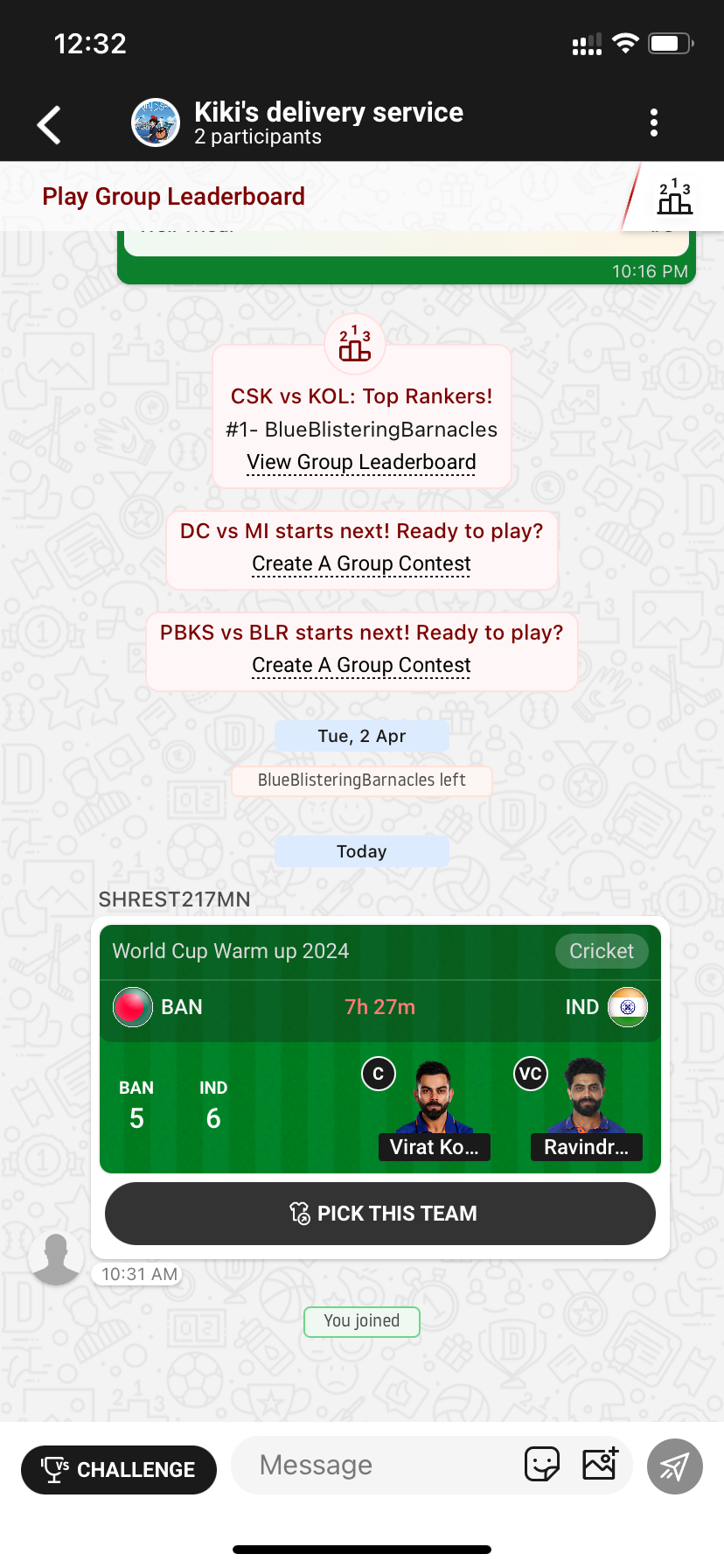
Groups often became inactive when conversations stopped between matches. Instead of relying on users to restart them, the product started the conversation.

Automatic contests

Contests could repeat across the series without recreating them each time.

A group chat showing an automatic top rankers recap followed by a prompt to create a contest for the next match

The system starts the conversation

Post-match results and prompts gave groups a reason to return.

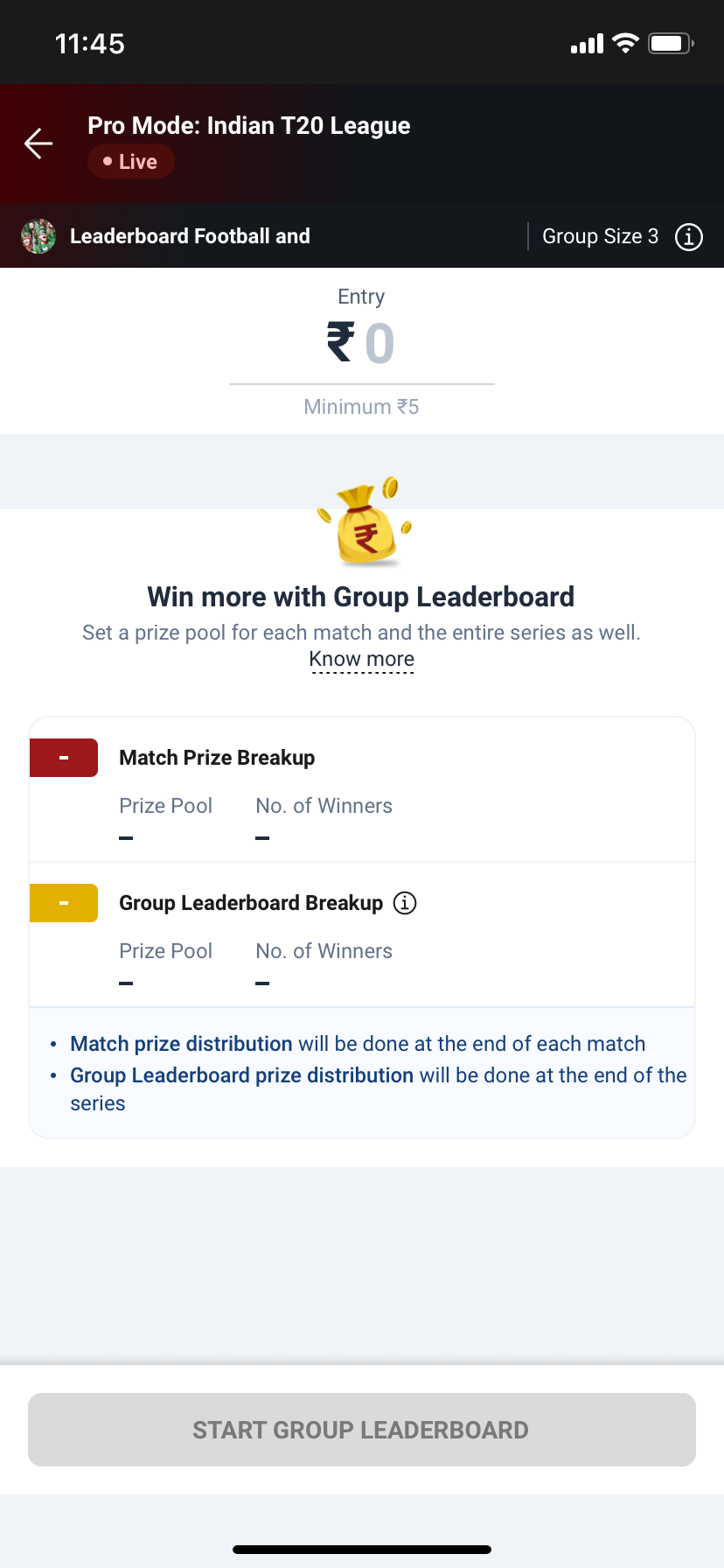
Group leaderboard setup showing a prize pool set for each match and for the entire series

Keep the competition going

Match and series-level prize pools gave groups longer-term reasons to participate.

Impact

  • Dormant groups became active again through system-generated messages.
  • DMs, automatic contests and system messages drove a 20–30% retention lift during IPL.
  • Overall social gameplay adoption and retention grew 2–3× across the first three IPLs.

What we learned

  • Scale needs guardrails. Group leaderboards created data and operational complexity at scale. We limited them to marquee tours.
  • Social needs boundaries. Open DMs increased scams, team selling and abuse. Richer messaging was retained in groups where moderation and reporting were stronger.

Privacy and Safety

Safety built into the experience.

Privacy, moderation and anti-fraud controls were part of the product from the start.

System levelAutomated checks for shared text, images and profile pictures, with stronger controls for repeat offenders.
Policy levelGovernment compliance, regular policy updates, a redressal process and manual moderation.
User levelBlock users, report content and remove members from groups.
Own info and access controls: profile overflow menu into Permissions and Settings, covering social and contact settings, personal information, gameplay and strategic info, and block/unblock. Report and block others: DM overflow menu into report profile and requests' settings

The Outcomes

Five years of social gameplay.

Social became a core part of how people played Dream11.

  • 2–3× year-on-year adoption and retention growth across three IPL seasons.
  • 40% of app screens were social by 2023.
  • Higher retention: Social gameplay users retained better than non-social users.
  • Higher trust: Gameplay-led profiles and Winners reduced trust-related queries and complaints.
  • New product opportunity: Team sharing led to the Guru Teams marketplace.
  • 10,000+ members in the largest groups, with 500 contests shared per day.

Social through the years

2019
Started building social as a mechanism to increase engagement between friends on the Dream11 app.
  • JanNetwork model (follow and following)
  • MarFeed, with the ability to share teams and contests
  • JulFocus on trust: the Winners tab
  • DecImage share on Feed
2020
Higher focus on Feed and messaging within groups.
  • JanLaunched groups, user search and phonebook sync
  • MarContest invites, report abuse on Feed
  • AprComments on Feed. Revamped Profile 2.0 with better stats, profile picture and design
  • JunVideo, polls and comments on Feed, official pages, social in the leaderboard
  • SepGroup leaderboard and the ability to create contests within groups
  • NovContest cards, improved report-abuse functionality on chat
2021
Pivoted to social-enabled gameplay. Invested in deeper contest-chat integration and moved away from Feed and UGC.
  • Jan"Sportan" user type, follow recommendations
  • MarChanges per the intermediary guidelines, system messages for group leaderboard and contest creation
  • AprDMs (1 to 1 chat), restricted single-member groups, friend addition to groups
  • AugStopped UGC on Feed
  • SepRematch, challenges in DMs
  • NovDynamic contest cards with real-time data, start of the React Native migration for social screens
2022
Increased focus on social in gameplay; explored collaborative gameplay and group-leaderboard incentivisation through POCs.
  • AprChat tab revamp, automatic contests, H2H history in DMs, My Network tab, network band on match card and contest home
  • AugIncentivised group-leaderboard POC
  • SepTeam share on chat, reactions, multi-tour group leaderboard
  • NovClan vs Clan POC
2023
  • JanDecoupled the network model from DMs and challenges
  • MarImproved contest invite design, Clan vs Clan POC 2
  • JulRematch for 2 to 10 member contests